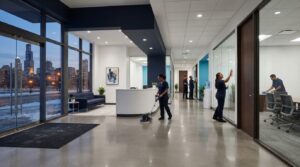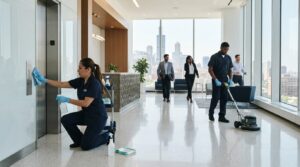
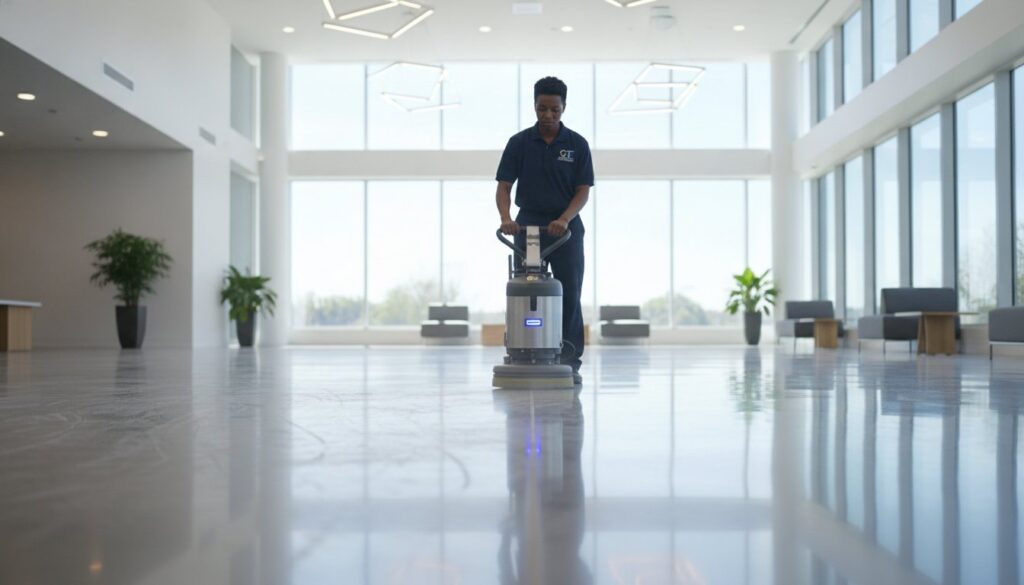
What if the dull, salt-stained surfaces dragging down your brand image don’t actually need to be replaced? You’ve likely looked at those scratched tiles or worn wood and felt the heavy burden of a looming capital expense. Choosing hard floor restoration commercial services can often save your budget and your sanity. It’s frustrating to see your facility lose its professional luster; especially when winter salt and heavy foot traffic in the Chicago area seem to win the battle every single season. You aren’t alone in feeling that the only solution is a costly renovation.
We believe that a restored floor brings a sense of tranquility to your workspace and removes a significant operational burden from your shoulders. This guide explores how professional techniques can breathe new life into your existing surfaces. You’ll discover how to revitalize your facility without the disruption of a total replacement. We’re going to debunk five common myths that are currently draining your maintenance budget and increasing your liability risks. By the end, you’ll have a clear path toward a cleaner, safer, and more cost-effective facility.
Key Takeaways
- Mopping alone won’t restore a floor’s luster because it doesn’t address the structural wear layer. You’ll learn how a deep-level reset can bring back your facility’s professional image and your peace of mind.
- Choosing hard floor restoration commercial services is often more cost-effective than a total replacement because it avoids business downtime and disposal fees.
- Properly maintained floors are critical for safety. You’ll see how professional restoration supports slip resistance on your busiest floors.
- Chicagoland winters present unique challenges like salt damage and chemical etching. Discover specialized techniques to protect your surfaces and remove the burden of seasonal floor decay.
- A successful restoration starts with a professional assessment. We’ll show you the steps, from moisture testing to deep stripping, that lead to a long-lasting finish.
Beyond the Mop: Why Daily Cleaning Isn’t Floor Restoration
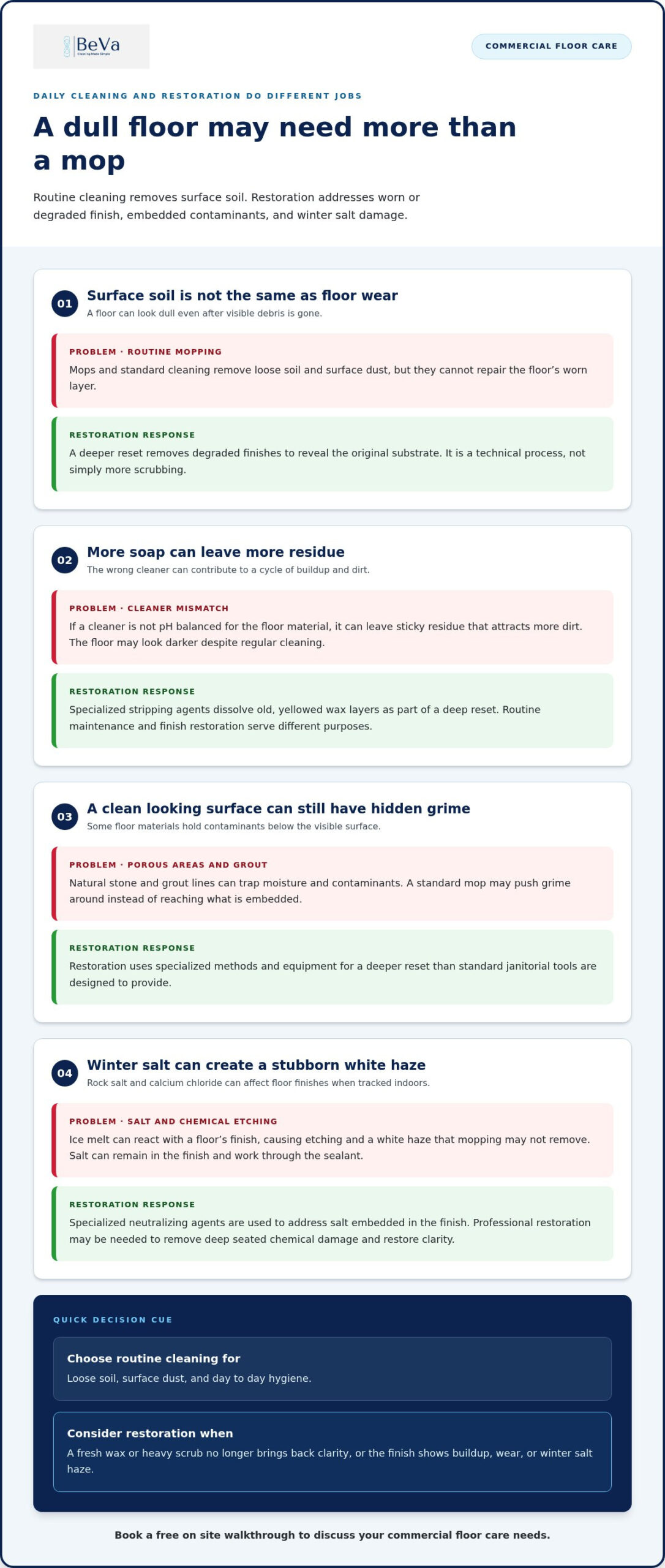
Many facility managers believe that if their floors look dull, the solution is simply to mop more often or use more soap. This is a common misconception that often leads to wasted labor hours and frustrated staff. Daily cleaning is essential for hygiene, but it’s fundamentally different from a structural reset. While standard floor cleaning methods remove loose soil and surface dust, they cannot repair the wear layer of your flooring or reverse the effects of heavy traffic.
Hard floor restoration commercial services involve a technical process that goes beneath the surface. It’s not about scrubbing harder; it’s about chemistry and mechanical precision. While routine maintenance relies on pH-balanced cleaners to protect the finish, restoration utilizes specialized stripping agents to dissolve old, yellowed wax layers. Standard janitorial equipment, like microfiber mops and basic scrubbers, isn’t designed to reach contaminants embedded deep within the floor’s pores or to level out the microscopic scratches that scatter light. Restoration is the removal of degraded finishes to reveal the original substrate.
The Limitations of Standard Janitorial Contracts
Daily crews are trained for speed and surface-level hygiene. They focus on removing visible debris, which is vital for day-to-day operations. However, these teams often lack the heavy-duty machinery and specialized technical training required for a deep reset. Over time, the use of incorrect cleaning agents can lead to a "buildup" effect. If a cleaner isn’t perfectly pH-balanced for your specific material, it leaves a sticky residue that actually attracts more dirt. This creates a frustrating cycle where the floor looks darker and dingier despite being cleaned every night.
When "Clean" Isn’t "Safe": The Hidden Grime
A floor can be free of visible debris and still be a liability. Porous materials like natural stone or grout lines act like sponges, trapping bacteria and moisture that a standard mop just pushes around. Beyond hygiene, the physical texture of the floor changes over time. Thousands of microscopic abrasions from foot traffic act like tiny mirrors pointing in different directions. Instead of a clear, bright reflection, you get a muddy, matte appearance that impacts your brand’s image and suggests a lack of care.
When you reach the point where even a fresh wax or a heavy scrub doesn’t bring back the clarity, your maintenance strategy must transition to restoration. Investing in a professional hard floor restoration commercial project removes these operational burdens. It restores the safety of the surface and provides the psychological tranquility of a workspace that truly shines for your clients and your team.
The Anatomy of Commercial Floor Decay: Why Surfaces Lose Their Luster
Commercial floors don’t just get dirty; they undergo a physical and chemical breakdown that compromises their structural integrity. High-traffic lanes are the most visible sign of this decay. As employees and customers walk the same paths daily, their footwear acts like sandpaper, grinding away the protective finish and leaving the substrate vulnerable. This mechanical wear is often accelerated by heavy equipment or the constant shifting of furniture, which creates deep scratches that trap soil. Even sunlight plays a role. UV degradation can cause sealants to become brittle and yellow, leading to a brittle surface that flakes away under pressure.
Maintaining these surfaces is about more than just aesthetics. According to OSHA safety and maintenance requirements, facility managers must keep floors in a clean, dry, and safe condition to prevent workplace injuries. When the protective wear layer fails, the floor becomes more difficult to sanitize and more prone to becoming a slip hazard. Investing in hard floor restoration commercial processes ensures that these decay patterns are reversed before they lead to permanent damage or safety violations.
Chicagoland’s Winter Toll on Hard Surfaces
In the Chicago and Northwest Indiana area, winter brings a unique set of challenges that standard cleaning routines can’t handle. Rock salt and calcium chloride are highly corrosive. When these ice melts are tracked inside, they react chemically with your floor’s finish, causing a process known as etching. This results in the notorious "white haze" that seems impossible to mop away. Without specialized neutralizing agents, this salt remains embedded in the finish, slowly eating through the sealant and reaching the tile or stone beneath. Professional restoration is often required to remove this deep-seated chemical damage and restore the floor’s original clarity.
Substrate-Specific Decay Patterns
To minimize the impact of these outdoor contaminants, many facility managers prioritize keeping sidewalks and entryways clear. Utilizing professional exterior maintenance services can significantly reduce the volume of corrosive salt and grit that enters your building, making your interior restoration efforts even more effective.
Different materials react to stress in unique ways. VCT and LVT floors are prone to scuffing and yellowing as the factory finish or old wax layers oxidize. If left untreated, these floors lose their resilience and become brittle. Natural stone and terrazzo face a different threat: salt-induced pitting. The alkaline nature of winter salts can create microscopic holes in the stone, leading to a rough texture that’s impossible to keep clean. In warehouse environments, concrete floors often suffer from "dusting," where the surface breaks down into a fine powder that settles on inventory and equipment. Identifying these patterns early allows you to implement hard floor services that target the specific needs of your facility, bringing back a sense of operational tranquility.
Restoration vs. Replacement: The Financial Myth of "Starting Over"
Many facility managers feel that once a floor looks "too far gone," the only choice is to rip it out. This "starting over" mentality is often a costly mistake that ignores the structural potential of your existing substrate. By choosing hard floor restoration commercial services, you can revitalize surfaces like VCT, stone, or hardwood for a fraction of the capital investment required for new materials. Restoration doesn’t just improve the look; it adds a protective layer that can extend the lifecycle of your flooring by 10 years or more.
Beyond the direct financial savings, restoration is the more responsible choice for the environment. Tearing out thousands of square feet of flooring creates massive amounts of landfill waste. Revitalizing your current surfaces aligns with modern sustainability goals, such as those found in Environmental Product Declarations (EPDs), by reducing the carbon footprint associated with manufacturing and transporting new materials. It’s a way to demonstrate social responsibility while protecting your bottom line.
Cost-Benefit Analysis for Facility Managers
When you look at the numbers, the argument for restoration becomes even stronger. According to 2026 industry data, refinishing hardwood floors typically costs far less than a full replacement, which involves high material costs, labor for tear-out, and the purchase of new inventory. Generally, restoration costs are typically 70-80% lower than replacement. There’s also a hidden ROI in your utility bills. Restored floors have higher light reflectivity, which means you can achieve the same level of brightness with fewer light fixtures, directly reducing your facility’s energy consumption.
Minimizing Operational Downtime
Business interruption is perhaps the most significant "hidden cost" of a floor replacement. A full tear-out can shut down entire departments for weeks, leading to lost revenue and logistical headaches. Professional hard floor restoration commercial projects are designed to remove this burden and provide operational tranquility. Modern curing agents and high-performance finishes allow for much faster turnaround times than traditional methods. We can schedule work in phases or during night shifts to ensure your facility remains open and functional. This strategic approach provides the benefit of a beautiful environment without the chaos of a construction zone.
Safety, Liability, and the Hidden Psychology of Restored Floors
A floor’s condition goes far beyond its visual appeal. It serves as the foundation of your facility’s safety profile. When a surface’s finish wears down, it loses its grip, significantly increasing the risk of workplace injuries. Slips, trips, and falls account for over 20% of all nonfatal workplace injuries, making them a primary concern for any facility manager. Professional hard floor restoration commercial services aren’t just cosmetic; they’re a proactive measure to ensure your environment remains safe for everyone who walks through your doors.
We believe that a well-maintained environment removes the heavy burden of liability from your shoulders. When you invest in restoration, you aren’t just fixing a floor; you’re protecting your people and your brand. This commitment to safety creates a culture of care that resonates with both employees and visitors, establishing your business as a leader in professional standards.
Workplace Safety and Slip Resistance
The technical goal of restoration is to return the Coefficient of Friction (COF) to safe levels. Over time, wax buildup or chemical etching creates a slick surface that lacks the necessary traction. By stripping away these degraded layers and applying high-quality finishes, we restore the floor’s slip-resistant properties. This is particularly vital as OSHA’s National Emphasis Program on Falls intensifies in 2026, with a renewed focus on training and documentation. For a deeper look at these requirements, see The Critical Link Between Floor Maintenance and Workplace Safety in 2026. Maintaining documented proof of professional floor care can be a critical asset during insurance audits or liability claims.
The Brand Impact of a Restored Facility
There is a powerful psychological phenomenon known as the "Halo Effect" where one positive trait influences the perception of an entire business. When a client walks into a lobby with gleaming, restored floors, they subconsciously associate that cleanliness with professionalism, safety, and high standards. Conversely, a dull or scratched floor can signal neglect, even if your services are top-tier. In the competitive Chicago commercial real estate market, these first impressions are essential for tenant retention and brand loyalty.
A clean environment also fosters a sense of tranquility for your employees. Removing the visual clutter of scuffs and salt stains reduces the subtle, daily stress of an unkempt workspace, which directly impacts morale and productivity. We view ourselves as your dependable partner in creating this atmosphere of professional excellence. If you’re ready to improve your facility’s safety and image, consider our specialized Hard Floor Services to restore your peace of mind.
Implementing a Professional Restoration Strategy in Chicagoland
Once the assessment is complete, the physical restoration begins with deep stripping. This step involves removing every trace of old, yellowed wax and localized contaminants that have bonded to the surface. Following this, we move to precision honing or sanding, depending on whether you have natural stone, wood, or resilient tile. This mechanical process levels the floor and removes the microscopic scratches that cause a dull appearance. The final step is the application of high-performance commercial sealants. These advanced coatings provide a durable wear layer that resists future salt damage and high-traffic abrasions, restoring the tranquility of a pristine workspace. Choosing the correct sealant is essential for preventing the re-absorption of contaminants into the floor’s pores.
Offices in Munster and Chicago face different traffic patterns than industrial warehouses in Crown Point. We believe in tailoring restoration cycles to these specific needs rather than following a generic schedule. For many facilities, integrating a deep restoration with recurring janitorial services is the best way to protect your investment. Regular maintenance keeps the new finish clean, while scheduled restoration resets the wear layer before damage reaches the substrate. You can find more details on balancing these services in The Comprehensive Guide to Commercial Floor Maintenance Services.
Choosing a Dependable Restoration Partner
Local expertise matters when selecting a partner for hard floor restoration commercial projects. A vendor who doesn’t understand Chicagoland weather patterns might use finishes that can’t withstand the alkaline nature of local ice melts. When interviewing potential partners, ask about their specific equipment types and their commitment to chemical safety. You deserve a team that operates with professional authority but maintains a grounded, community-focused feel.
The BeVa promise is built on being a principled expert. We combine technologically advanced methods with traditional virtues like honesty and hard work. Our goal is to remove the operational burden of floor maintenance from your shoulders, allowing you to focus on your core business. We don’t just provide a service; we act as a dependable partner dedicated to the health and growth of your facility’s environment.
Revitalize Your Facility’s Foundation
Choosing a professional path for your surfaces means moving beyond the temporary fix of daily mopping. We’ve explored how a structural reset can extend the life of your floors by a decade while significantly reducing your liability risks. By debunking the myth that dull floors require total replacement, you can reclaim your budget and your brand image simultaneously. Restoration is a strategic investment that brings clarity and tranquility back to your professional environment. It’s about protecting your assets while creating a workspace that reflects your high standards.
As a dependable partner serving Munster, Dyer, Highland, Crown Point, and Chicago, we bring specialized technical training to every high-traffic commercial environment. Our local expertise ensures your surfaces withstand the unique challenges of our regional climate. When you’re ready to see the true potential of your facility, our hard floor restoration commercial services are here to remove the burden of maintenance from your shoulders. We focus on the details so you can focus on your growth.
Take the first step toward a safer, more beautiful workspace today. Restore Your Floors with BeVa Cleaning Solutions and enjoy the confidence that comes with a perfectly maintained environment. Your facility deserves to shine, and we’re here to help you make it happen.
Frequently Asked Questions
How often should commercial floors be restored vs. just cleaned?
Cleaning should happen daily to remove debris, but restoration is a periodic structural reset. Most high-traffic facilities in the Chicago area benefit from a full restoration every 12 to 18 months. Low-traffic zones or private office suites might extend this cycle to 24 months or longer. The key is to monitor the wear layer. When daily mopping no longer brings back the shine, it’s time to transition from maintenance to a professional reset.
Will the hard floor restoration process disrupt my business hours?
We minimize operational burdens by scheduling our work during your off-hours. Restoration doesn’t have to mean closing your doors. Our teams often work night shifts or weekends to ensure your facility remains functional for employees and clients. Modern curing agents and high-performance sealants dry quickly, allowing for a fast turnaround. We can also perform work in phases to keep specific departments open while others are being serviced.
Is restoration effective for all types of commercial flooring like VCT and stone?
Professional restoration is effective for nearly all hard surfaces, including VCT, LVT, natural stone, terrazzo, and concrete. Each material requires a unique technical approach to achieve the best results. For example, natural stone may need mechanical honing to remove pitting, while VCT requires a deep strip and wax. Our specialized training ensures that the correct chemicals and equipment are used for your specific substrate, protecting your investment for years to come.
What is the difference between floor stripping and waxing and restoration?
Stripping and waxing is a specific process used for resilient floors, while hard floor restoration commercial is a comprehensive category of service. Restoration includes advanced techniques like mechanical honing for stone, diamond polishing for concrete, or sanding for hardwood. While stripping removes old wax, restoration addresses deeper structural issues like chemical etching or deep scratches in the substrate. It’s a more thorough reset that revitalizes the floor’s integrity rather than just refreshing the topcoat.
How long does a professional floor restoration typically last?
A professional restoration typically lasts between 12 and 24 months, though this depends heavily on your daily maintenance routine. High-traffic lanes in retail or healthcare environments may require more frequent attention than a corporate lobby. Using pH-balanced cleaners and keeping up with routine dust mopping will preserve the new finish. We partner with you to establish a maintenance schedule that extends the life of your restored floors and maximizes your return on investment.
Can restoration fix deep scratches or permanent salt damage?
Most deep scratches and chemical salt damage can be successfully repaired through the restoration process. Mechanical sanding or diamond honing levels the surface of the floor, effectively removing the damaged layer to reveal the fresh material beneath. This is particularly important for Chicago facilities dealing with winter salt etching. While some extremely deep structural cracks might require different repairs, restoration can handle the vast majority of surface-level abrasions and chemical pitting.
Is commercial floor restoration environmentally friendly?
Restoration is a highly sustainable choice because it prevents thousands of pounds of flooring material from ending up in local landfills. By revitalizing your existing substrate, you reduce the carbon footprint associated with manufacturing and transporting new materials. We also utilize modern sealants that meet current environmental standards. This approach supports your facility’s green initiatives while providing a clean, healthy environment that improves the psychological well-being of everyone who uses the space.
How much does hard floor restoration cost in Chicago?
The cost of a hard floor restoration commercial project in the Chicago area depends on several factors, including the type of material and the level of damage. Labor rates in the Chicagoland market and the specific chemicals required for salt neutralization can impact the total investment. While industry averages for specific materials exist, every commercial facility has unique needs. The best next step is an on-site walkthrough, where we look at your building’s square footage and condition.