Did you know that the average workers’ compensation claim for a single slip and fall incident has now reached $48,000? For business owners across Chicago and Northwest Indiana, this number represents more than a financial risk; it is a source of constant operational stress. You likely already understand the weight of rising insurance premiums and the anxiety that comes with maintaining commercial floor slip resistance during a busy shift. It is difficult to find tranquility in your workspace when technical requirements like DCOF and SCOF feel like ever-shifting targets.
We are here to clear that confusion and show you how professional maintenance protocols directly influence safety to protect your business from liability. By prioritizing the science of floor care, you can remove the burden of safety concerns and focus on growth. This article previews the essential ANSI A326.3-22 standards for 2026, explains why the industry has moved toward dynamic friction measurements, and provides a clear strategy for staying compliant with OSHA while extending the life of your hard floors.
Key Takeaways
- Understand the critical shift from SCOF to the modern ANSI A326.3-22 standards to ensure your facility meets current safety benchmarks.
- Learn how invisible soap film and chemical buildup can compromise commercial floor slip resistance even on high-traction surfaces.
- Discover proactive maintenance strategies for managing regional hazards like winter salt and slush in Chicago and Northwest Indiana.
- Identify the specific dynamic friction values required for different facility zones to stay ahead of 2026 OSHA enforcement trends.
- Explore how professional janitorial partnerships help remove operational burdens while creating a safer environment for your community.
Understanding Commercial Floor Slip Resistance and Its Impact
At its core, commercial floor slip resistance is the interactive force generated between a person’s footwear and the walking surface. It is the invisible grip that keeps your team upright and your operations moving smoothly. According to OSHA, maintaining proper slip resistance is a vital safety measure that helps prevent 15% of all workplace fatalities. We view floor safety as a principled expert would; it isn’t just a checkbox for compliance, but a moral and operational imperative. When your facility is truly safe, you gain a sense of tranquility that allows you to focus on your core business goals without the constant weight of liability hanging over your head.
A common trap for facility managers is believing that a floor that looks clean is inherently safe. Visual shine can be deceptive. A floor can be free of visible debris yet remain dangerously slick due to chemical residues or improper finishing techniques. True safety is measured by friction, not by how well the surface reflects overhead lighting. High-gloss finishes don’t always equate to high-traction environments, and assuming otherwise can lead to preventable accidents.
The High Cost of Slip-and-Fall Accidents
The financial impact of a fall goes far beyond the initial medical bills. While direct costs like legal defense fees and medical expenses are staggering, the indirect costs often hit harder. Businesses in Munster and Chicago frequently face lost productivity when key staff members are sidelined by injuries. Additionally, a single public incident can tarnish a brand’s reputation within the local community. Maintaining meticulous maintenance records isn’t just good practice; it’s a strategy to lower insurance premiums. Insurers value transparency and proof of a proactive safety culture, which directly supports your long-term bottom line.
Why Surface Texture is Only Half the Story
Many believe that choosing a textured tile or stone is enough to guarantee safety. However, texture is only part of the equation. Porous materials can trap microscopic contaminants, such as oils or fine dust, which eventually level out the surface and reduce friction. This is why Floor slip resistance testing is so critical. It measures how the surface actually performs under real-world conditions rather than relying on the manufacturer’s out-of-the-box rating.
The difference between dry and wet traction is where the most significant risks hide. For example, post-construction dust is a notorious hidden hazard in new facilities across the Chicago area. This fine particulate acts like microscopic ball bearings on a hard floor, creating a high-risk environment even if the floor appears brand new and dry. Consistent hard floor services are necessary to remove these deep-seated hazards and ensure the surface performs as intended for every visitor who walks through your doors.
The Science of Safety: DCOF, SCOF, and ANSI Standards
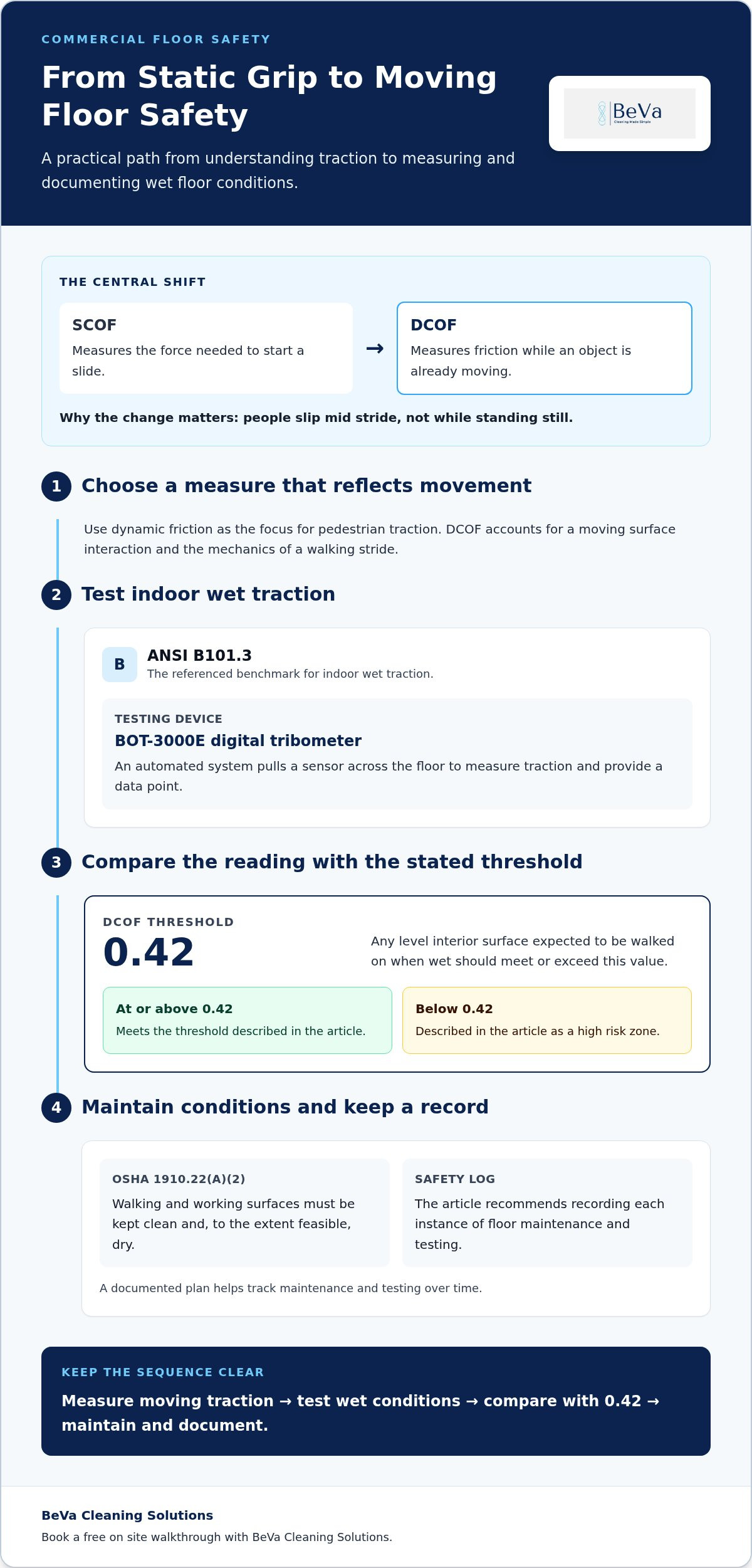
Understanding the physics of your flooring is the first step toward true peace of mind. The Coefficient of Friction (COF) serves as the primary metric for measuring commercial floor slip resistance. It represents the relationship between the force of friction and the weight of the object on the surface. In 2026, the industry has firmly transitioned away from Static Coefficient of Friction (SCOF) toward Dynamic Coefficient of Friction (DCOF). While SCOF measures the force required to start a slide, DCOF measures the friction of an object already in motion. This shift is vital because pedestrians don’t slip while standing still; they slip mid-stride.
To ensure accuracy and reliability, professionals rely on the ANSI B101.3 standard for indoor wet traction. This benchmark provides a reliable framework for assessing whether a floor is truly safe when conditions are less than ideal. Testing is performed using the BOT-3000E digital tribometer. This industry-standard device removes human error by using an automated system to pull a sensor across the floor. It provides a clear, defensible data point for your facility’s safety profile, replacing guesswork with hard science.
What is Dynamic Coefficient of Friction (DCOF)?
DCOF represents the friction between a moving object and a surface. It is the most accurate predictor of pedestrian slips because it accounts for the mechanics of a human gait. According to current national standards, the magic number for high-traction safety is 0.42. Any level interior surface expected to be walked on when wet should meet or exceed this 0.42 DCOF threshold. If your floors fall below this mark, they are considered a high-risk zone for accidents, regardless of how clean they might appear to the naked eye.
Regulatory Compliance: OSHA and Chicago Building Codes
OSHA 1910.22(a)(2) mandates that all walking and working surfaces must be kept in a clean and, to the extent feasible, dry condition. In high-traffic environments like Chicago office buildings, meeting this standard requires a proactive approach. Local building codes often mirror these national requirements, making it essential to have a documented plan. We recommend maintaining a detailed “Safety Log” that tracks every instance of floor maintenance and testing. This log acts as a shield against liability, proving that you have exercised due diligence in protecting your staff and visitors. Implementing consistent hard floor services ensures these metrics stay within the safe range, removing the operational burden of compliance from your shoulders.
How Maintenance Protocols Dictate Slip Resistance Trends
Many Chicago businesses have adopted “Green” cleaning solutions to align with corporate social responsibility. However, these formulas often contain high concentrations of surfactants. If a facility’s rinsing protocol is inconsistent, these surfactants dry into a microscopic film. This residue effectively acts as a lubricant. Even a surface that meets the 0.42 DCOF standard can become hazardous once this invisible layer is introduced. Maintaining commercial floor slip resistance requires more than just removing dirt; it requires managing the chemistry left behind on the surface.
The Danger of “Soap Scum” and Chemical Residue
Improper rinsing is a primary culprit in declining commercial floor slip resistance. When surfactants are left behind, they create what professionals call the “Ice Rink” effect. This happens when a seemingly dry floor suddenly loses all traction the moment a drop of water or a damp shoe hits the residue. The moisture reactivates the soap, turning the floor into a slide. To prevent this, using neutral cleaners is essential. These solutions are formulated to clean effectively without leaving the heavy alkaline deposits that compromise factory-rated safety levels.
Stripping and Waxing: Restoring the Safety Profile
Over time, floor finishes naturally degrade. Old, yellowed wax doesn’t just look unprofessional; it becomes brittle and loses its ability to flex under pressure. This brittleness can lead to microscopic “dusting,” where the finish breaks down into fine particles that reduce friction. Periodic Professional Floor Stripping and Waxing Services are necessary to remove these compromised layers and start fresh.
Modern floor care focuses on high-traction finishes, specifically those that are UL Classified for slip resistance. These finishes provide a durable, protective barrier that enhances the floor’s aesthetic while significantly improving safety. By removing the burden of managing these complex cycles, facility managers can ensure a consistent safety profile year-round. A principled approach to floor care means you don’t have to choose between a professional luster and the well-being of your community. Before assuming that worn or dull surfaces require full replacement, it is worth exploring whether hard floor restoration commercial services can revitalize your existing floors at a fraction of the cost.
Actionable Safety: Managing Hazards in Chicagoland Facilities
Winter in the Chicago area brings more than just cold temperatures; it introduces a constant influx of salt, slush, and moisture into your facility. These elements are the primary enemies of commercial floor slip resistance during the peak of the season. When pedestrians track in melting ice and abrasive salt, your floor’s safety profile can change in minutes. Managing these hazards requires a localized strategy that accounts for the specific weather patterns we face in Northwest Indiana and the city. A proactive approach doesn’t just prevent accidents; it provides the peace of mind that comes from knowing your environment is under control.
Entryway matting systems serve as your first line of defense. A high-quality matting program should include at least 15 feet of coverage to effectively remove moisture and debris from shoes before they touch your hard floors. To build a truly resilient maintenance plan, consult The Comprehensive Guide to Commercial Floor Maintenance Services. This resource details how to integrate matting with professional cleaning cycles to maximize safety.
Winter Safety Protocol for Northwest Indiana
The salt used on sidewalks in Munster and Dyer is highly abrasive. As it is tracked inside, it acts like sandpaper, grinding away at your floor’s finish and reducing its natural grip. This degradation is often invisible until a slip occurs. Day porter cleaning services are essential during snow events because they provide real-time moisture removal. Instead of waiting for a nightly crew, a day porter can address puddles and salt buildup as they happen, preventing “flash” slips that occur when a dry shoe suddenly hits a patch of brine.
A Facility Manager’s Daily Safety Checklist
Consistency is the foundation of a safe workplace. We recommend a daily walkthrough focused on high-risk “Transition Zones.” These are the areas where people move from one surface type to another, such as entryways, restrooms, and breakrooms. Your checklist should include the following points:
- Inspect all non-slip mats for curling edges or saturated fibers that no longer absorb water.
- Check transition strips between different flooring materials to ensure they are secure and flush.
- Monitor for “Dry Slips” caused by fine dust or post-construction debris, which can be just as dangerous as wet floors.
- Verify that high-traffic paths are free of salt crystals that can cause a loss of balance.
By identifying these risks early, you remove the operational burden from your staff and create a welcoming, secure space for everyone. If you are ready to upgrade your facility’s safety standards, our team can help you implement specialized janitorial cleaning protocols tailored to your specific needs.
Professional Janitorial Solutions for Slip Prevention
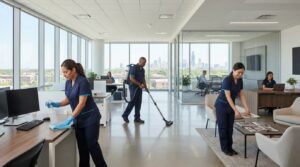
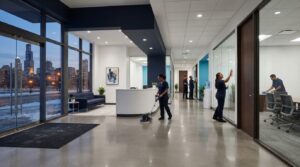
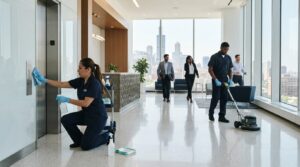
At BeVa Cleaning Solutions, we believe that a truly safe environment is built on a foundation of integrity and technical precision. We integrate a principled expert approach into every facility we serve, recognizing that floor care is a vital component of your overall risk management strategy. Our hard floor services transcend the traditional mop and bucket approach, which often does little more than spread contaminants around. Instead, we focus on the science of traction to ensure your facility remains a safe harbor for employees and the local community alike. By partnering with a specialist, you shift the operational burden of safety to a team that understands the nuances of 2026 compliance and liability reduction.
Standard cleaning often fails because it treats every surface the same. We customize our programs for the unique demands of Chicago retail shops, medical clinics, and industrial sites. Each of these environments faces different challenges, from the high foot traffic of a Munster shopping center to the chemical exposures of a Northwest Indiana manufacturing plant. This proactive stance ensures your commercial floor slip resistance remains within the optimal range, regardless of the specific hazards your industry presents.
Day Porter Services: Your First Line of Defense
The most dangerous slips often happen in the small window between a spill and its cleanup. Our day porter services provide a continuous presence during business hours, offering an immediate response to liquid incursions or tracked-in debris. This real-time monitoring is especially critical during the unpredictable Chicago winters when slush and salt can compromise entryways in seconds. By having a dedicated professional on-site, you minimize the “slip window” and provide a level of care that nightly cleaning alone cannot match. It’s a results-oriented solution that fosters tranquility for property managers who can’t afford to be everywhere at once.
Technical Floor Restoration and Protection
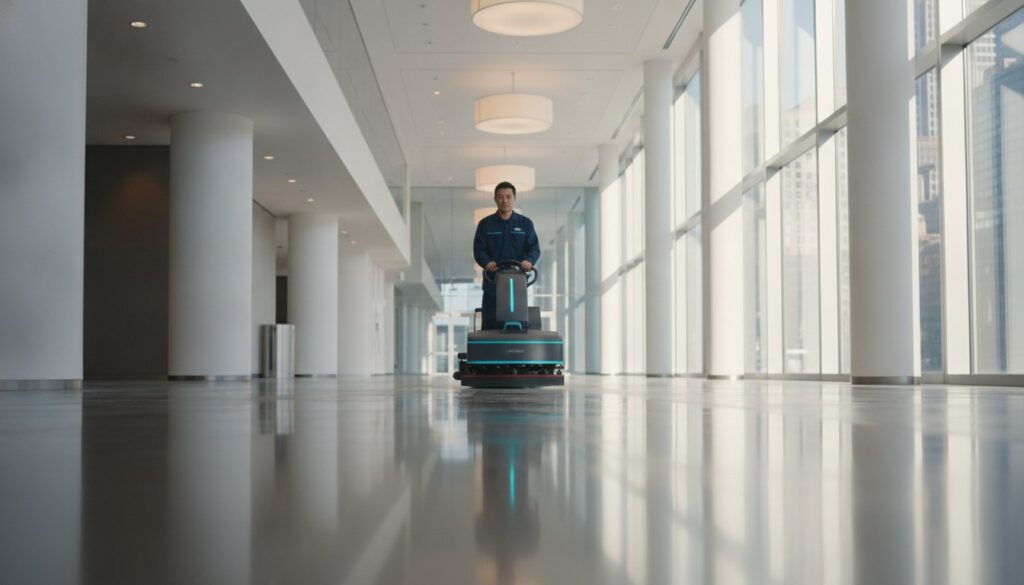
When a floor’s safety profile has degraded due to age or improper maintenance, a standard scrub isn’t enough. We use advanced equipment and transparent reporting to measure and restore the necessary friction levels. Many facility managers are surprised to learn that scratched, dull, or salt-stained surfaces that appear beyond saving are actually strong candidates for commercial hard floor restoration rather than costly replacement. Our process involves stripping away compromised finishes and applying high-traction, UL Classified protectors that are specifically designed to maintain commercial floor slip resistance. For a comprehensive look at how we maintain these high standards across the region, see The Ultimate Guide to Commercial Cleaning in Chicago. We provide the technical documentation you need to prove your commitment to safety, ensuring your facility is as legally sound as it is physically secure.
Securing Your Facility’s Future Through Expert Care
Your commitment to facility excellence starts with recognizing that safety is a dynamic process, not a static feature. We’ve explored how adopting current DCOF standards and managing invisible chemical residues are essential steps in protecting your team. In the Chicagoland area, the unique challenges of winter salt and slush require a localized, proactive strategy to maintain consistent commercial floor slip resistance. By prioritizing these professional protocols, you don’t just meet OSHA requirements; you create a workspace defined by tranquility and operational clarity.
BeVa Cleaning Solutions stands as your dependable partner, serving Munster, Dyer, Highland, and the greater Chicago area with integrity. Our expert hard floor maintenance and comprehensive janitorial contracts are designed specifically for liability reduction in industrial and commercial facilities. We remove the operational burden of technical floor restoration so you can focus on your core mission. Take the first step toward a safer, more efficient environment today. Request a Hard Floor Safety Assessment from BeVa Cleaning Today and experience the peace of mind that comes from professional excellence.
Frequently Asked Questions
What is the minimum DCOF for a safe commercial floor?
The minimum Dynamic Coefficient of Friction (DCOF) for a level interior surface expected to be walked on when wet is 0.42. This standard, established by ANSI A326.3-22, serves as the primary benchmark for high-traction safety in 2026. Maintaining this value is essential for reducing the risk of workplace accidents. Our specialized testing protocols ensure your facility stays within this safe range, providing the hard data needed for liability protection.
How often should commercial floors be stripped and waxed for safety?
Most high-traffic facilities require professional stripping and waxing once or twice per year to maintain a safe profile. This frequency depends on foot traffic and the specific environment, such as industrial sites versus retail shops. Over time, old finish becomes brittle and loses its ability to provide adequate commercial floor slip resistance. Regular restoration removes these compromised layers and applies fresh, high-traction finishes that protect your flooring investment and your team.
Can cleaning chemicals actually make my floors more slippery?
Yes, improper chemical use is a leading cause of slippery floors. If “Green” cleaners or heavy surfactants aren’t rinsed thoroughly, they leave behind a microscopic film. This residue acts as a lubricant, especially when reactivated by a small amount of moisture. We use neutral cleaners and precise rinsing protocols to prevent this “Ice Rink” effect. This approach ensures your commercial floor slip resistance remains intact without the hidden hazard of chemical buildup.
Does OSHA require specific slip-resistance testing for commercial buildings?
OSHA does not mandate a specific DCOF number, but it requires that all walking and working surfaces be kept in a clean and dry condition under regulation 1910.22. To meet this requirement, businesses often follow consensus standards like ANSI A326.3-22. Documenting your testing results shows a good-faith effort to comply with safety guidelines. This proactive documentation is a vital part of a principled expert’s approach to facility risk management and liability reduction.
What are the best flooring materials for slip resistance in high-traffic areas?
Textured porcelain tile and high-quality luxury vinyl plank (LVP) are excellent choices for maintaining traction in busy areas. These materials are often engineered to meet the 0.42 DCOF threshold right out of the box. However, even the best material requires a consistent maintenance schedule to stay safe. Without regular cleaning to remove oils and dust, even high-traction surfaces will eventually lose their grip and become a safety hazard for your visitors.
How does winter weather in Chicago affect indoor floor safety?
Chicago winters introduce abrasive salt and melting slush that can degrade floor finishes in a matter of hours. Salt crystals act like sandpaper, grinding down the protective wax and reducing the floor’s natural traction. Additionally, the constant influx of moisture creates immediate slip hazards at every entrance. We recommend a combination of robust entryway matting and frequent day porter cycles to manage these seasonal risks effectively while keeping your facility clean and secure.
Is a day porter service effective for preventing slip-and-fall accidents?
A day porter service is one of the most effective ways to prevent accidents in real time. Unlike nightly crews, day porters monitor high-traffic zones during business hours to address spills and moisture immediately. This continuous oversight removes the operational burden from your management team and ensures that hazards are cleared before they result in a fall. It’s a results-oriented solution that prioritizes the safety and psychological tranquility of your professional workspace.
What is the difference between SCOF and DCOF testing?
Static Coefficient of Friction (SCOF) measures the force needed to start a slide from a standstill. Dynamic Coefficient of Friction (DCOF) measures the friction of an object already in motion. Because most slips occur while a person is walking, DCOF is the more accurate metric for pedestrian safety. The industry has moved toward DCOF testing with digital devices to provide a more realistic assessment of real-world risks compared to older, less reliable SCOF methods.