
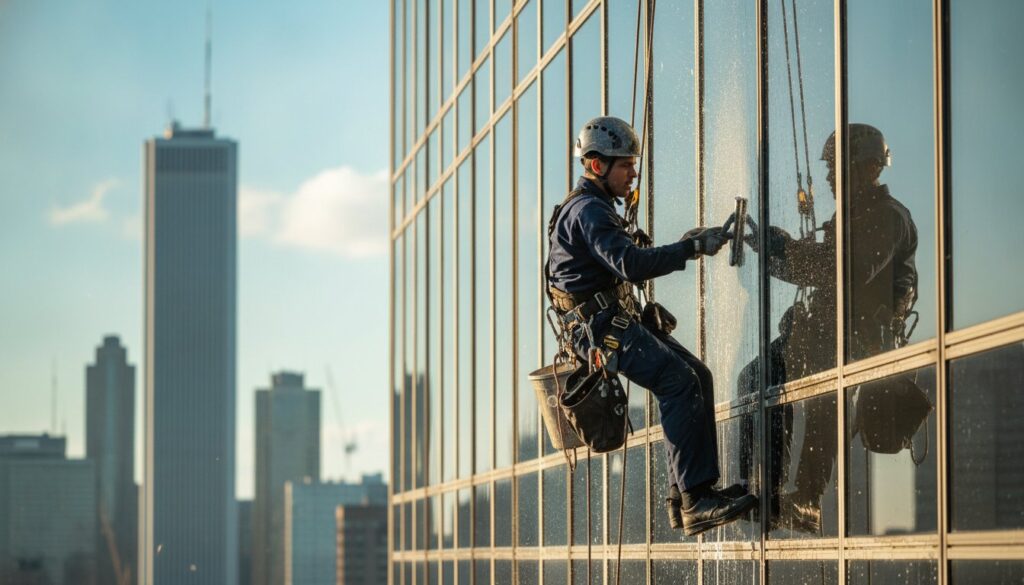
Did you know that Chicago now boasts more than 1,250 high-rise buildings, each constantly battling the corrosive effects of Lake Michigan winds and urban pollutants? Maintaining these vertical landscapes requires more than just basic maintenance; it demands a sophisticated approach to high rise window cleaning Chicago property managers can rely on to protect their long-term asset value. You probably already feel the weight of managing these massive structures, especially when balancing the need for a pristine exterior against the heavy responsibility of safety compliance and tenant satisfaction.
It’s a high-stakes environment where a single oversight in anchor point certification or a lapse in vendor communication can lead to significant liability. This 2026 manager’s guide is designed to help you master the technical, safety, and financial aspects of skyscraper maintenance so you can remove the operational burden from your shoulders. We’ll walk through the latest OSHA standards for rope descent systems, the impact of the city’s "Lights Out" program on your seasonal scheduling, and the specific strategies used to prevent permanent glass degradation. By the end of this article, you’ll have the clarity needed to ensure a zero-incident safety record and a building that reflects the professional excellence of your management team.
Key Takeaways
- Learn why consistent maintenance is a vital financial strategy to prevent permanent glass etching and protect your building’s long-term asset value.
- Understand the mandatory 2026 OSHA 1910.27 standards for anchor point certification to eliminate liability and protect your facility.
- Identify the most efficient methods for high rise window cleaning Chicago based on your building’s unique architectural complexity and height.
- Master the vetting process for high-access vendors by asking for specific safety metrics like EMR scores and OSHA 300 logs.
- Discover how a principled approach to facility maintenance can remove operational burdens and provide peace of mind for your entire management team.
Why Chicago High-Rise Window Cleaning is a Strategic Asset Investment
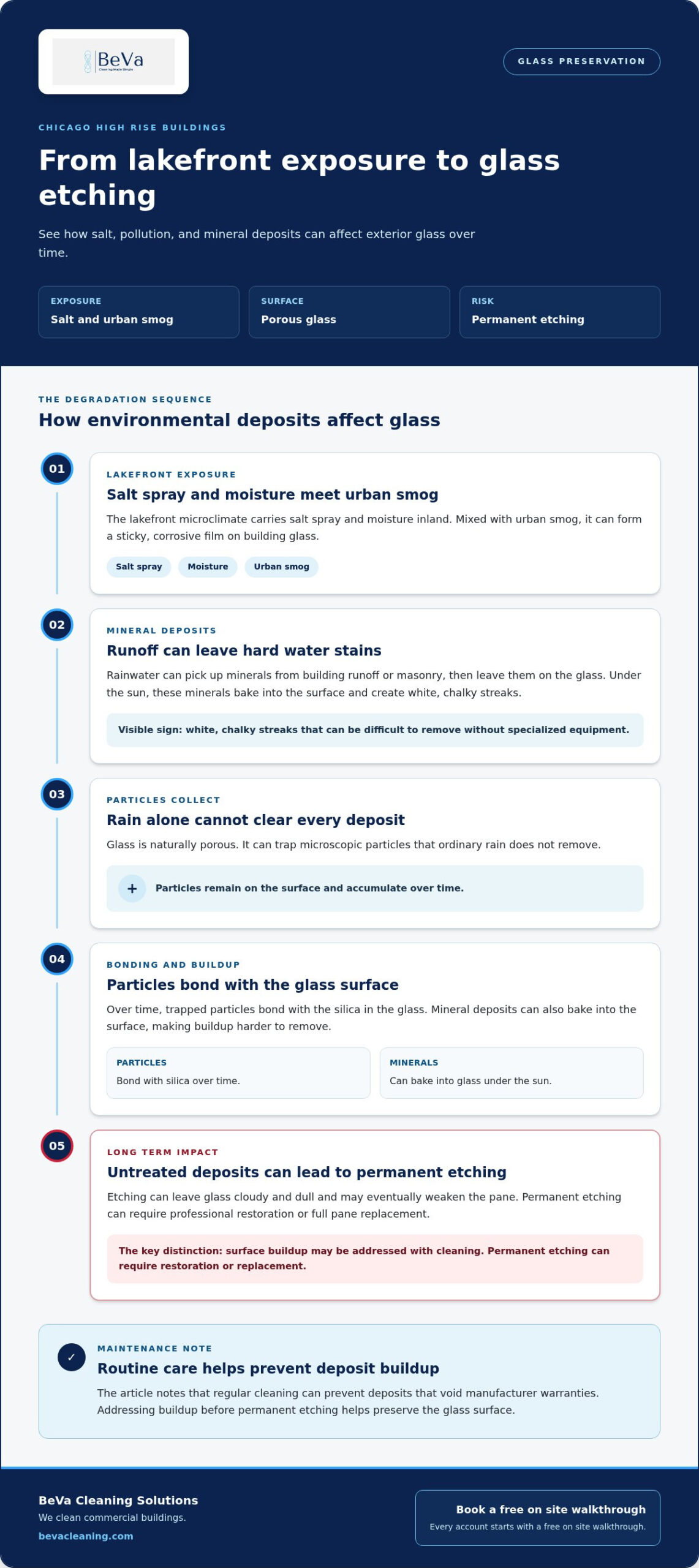
Many property managers view exterior maintenance as a seasonal line item, but in a vertical city like ours, it’s a fundamental defensive strategy for your building’s envelope. High rise window cleaning Chicago services provide more than just a clear view; they act as the primary barrier against the gradual destruction of your building’s most visible asset. When you look at a skyscraper, you aren’t just looking at glass; you’re looking at a porous material that’s constantly under attack from the environment. Glass oxidation is the chemical reaction between environmental pollutants and the glass surface that leads to a cloudy, dull appearance and eventual structural weakening of the pane, directly impacting the building’s valuation.
Because glass is naturally porous, it traps microscopic particles that can’t be removed by rain alone. Over time, these particles bond with the silica in the glass. If left untreated, this leads to permanent etching that requires costly professional restoration or full pane replacement. Maintaining a pristine exterior is also a psychological driver for occupancy. Class A tenants expect a level of excellence that begins before they even enter the lobby. A sparkling facade signals that the building is managed with integrity and attention to detail, which directly supports higher retention rates and premium lease pricing.
Combating Urban Pollutants and Lakefront Salt
The "Chicago Effect" is a unique challenge caused by our proximity to Lake Michigan. The lakefront microclimate carries salt spray and moisture blocks inland, which mixes with urban smog to create a sticky, corrosive film. This mixture is particularly aggressive compared to inland cities. Another common issue is hard water staining, which occurs when rainwater picks up minerals from building runoff or masonry and deposits them onto the glass. These minerals bake into the surface under the sun, creating white, chalky streaks that are difficult to remove without specialized equipment. For a deeper look at how these factors fit into a total facility plan, you can explore The Ultimate Guide to Commercial Cleaning in Chicago.
The ROI of Regular Exterior Maintenance
Investing in routine maintenance is significantly more cost-effective than reactive restoration. While the window cleaning profession has evolved to handle complex architectural challenges, the chemistry of glass remains the same. Regular cleaning prevents the buildup of deposits that void manufacturer warranties. Beyond preservation, clean windows improve interior lighting, which reduces the reliance on artificial light and lowers energy costs for tenants. It’s a proactive step that removes the operational burden of emergency repairs while ensuring your building remains a landmark of quality in the Chicago skyline. For a comprehensive overview of compliance requirements and long-term preservation strategies, the Exterior Building Window Cleaning: The 2026 Facility Manager’s Reference provides an essential framework for modern facility teams.
The Gold Standard of Safety: OSHA Compliance and Rope Access Protocols
High-access work is inherently risky, but modern safety protocols turn that risk into a managed variable. For property managers overseeing high rise window cleaning Chicago, safety isn’t just about avoiding accidents; it’s about robust liability protection for the asset. Industrial Rope Access (IRA) has emerged as the premier method for vertical maintenance. It uses a dual-rope system where one line serves as the primary support and the second line acts as a redundant safety backup. This redundancy ensures that even in the unlikely event of a primary line failure, the technician remains securely suspended.
Compliance with OSHA’s Rope Descent System regulations is the baseline for any professional operation. Under these rules, every anchor point used for high-access work must support a minimum of 5,000 pounds per worker. It’s vital to remember that building owners are legally required to provide written certification that these anchorages are identified, tested, and maintained. Beyond federal rules, the industry looks to SPRAT (Society of Professional Rope Access Technicians) or IRATA (Industrial Rope Access Trade Association) for certification standards. A team led by a Level 3 supervisor provides the highest degree of technical oversight, which directly shields building owners from operational risk.
Fall Protection and Anchor Point Integrity
The legal responsibility for anchor point maintenance rests squarely on the building owner’s shoulders. Each anchor point must be certified at least once every ten years, with mandatory annual inspections to ensure structural integrity hasn’t been compromised by Chicago’s harsh weather. We believe that "safety first" is more than a slogan; it’s a core value that guides every move our team makes. Every project begins with a rigorous pre-work checklist to verify that all systems are operational before a single technician leaves the roof. This disciplined approach removes the psychological burden of worry from your management team.
The Benefits of Industrial Rope Access (IRA)
Rope access offers several advantages over traditional scaffolding or heavy machinery. It’s often safer because it requires fewer technicians and less equipment to achieve the same result. In a dense urban environment, IRA provides minimal disruption to your high-value tenants. There are no bulky platforms blocking lobby entrances or city sidewalks, and the systems can be deployed and retracted quickly each day. This versatility is essential for Chicago’s intricate architectural designs where tight urban spaces make traditional access impossible. If you want a partner who prioritizes your building’s safety as much as you do, consider how BeVa Cleaning Solutions can streamline your maintenance schedule.
Selecting the Right Method: Rope Access vs. BMUs vs. Aerial Lifts
Selecting the most efficient method for high rise window cleaning Chicago requires a clear framework based on your building’s height, architectural complexity, and surrounding ground space. Each structure in the Chicago skyline presents a different puzzle. While some managers inherit permanent equipment, others must choose between temporary installations or highly mobile rope systems. Understanding these options allows you to balance your budget without sacrificing the pristine results your tenants expect.
Rope access is often the most versatile choice for modern skyscrapers. It’s particularly effective for complex facades where traditional platforms can’t reach. Building Maintenance Units (BMUs), while convenient for some, come with high long-term maintenance costs and potential mechanical downtime. For buildings under ten stories, aerial lifts might be the optimal choice, provided you have the necessary sidewalk clearance and city permits.
When to Use Rope Access for Chicago Facades
The narrow streets and "wind tunnels" of the Loop require a method that’s both agile and discrete. Rope access technicians can maneuver around unique geometry and deep-set windows that would trap a traditional basket. This method is also highly cost-efficient; it eliminates the need for expensive equipment rentals and reduces setup time from days to hours. When evaluating your options, consult OSHA rope descent system height limits to verify that your planned descent stays within the 300-foot guideline for standard rope systems without intermediate ties. Beyond the financial savings, rope access has a lower carbon footprint, aligning your maintenance with modern sustainability goals.
BMU Maintenance and Auxiliary Cleaning
If your building utilizes a BMU, it’s critical to ensure the operators are specifically trained on your hardware. These permanent cranes are complex machines that require regular inspection and expert handling to avoid damaging the building’s exterior. It’s also a common mistake to assume a BMU can reach every pane. Most high-rises have "dead zones" or recessed areas that require supplemental rope access to achieve a truly uniform finish. Integrating these specialized tasks with Industrial Cleaning Services in Chicago creates a comprehensive maintenance plan that protects your asset from every angle. This holistic approach ensures that your facility remains a beacon of professional excellence, removing the operational burden of managing multiple specialized vendors.
A Property Manager’s Checklist for Hiring High-Rise Cleaners in Chicago
Selecting a vendor for high rise window cleaning Chicago is one of the most critical decisions in a facility manager’s annual cycle. It’s a choice that impacts your liability profile as much as your building’s appearance. A standard general liability policy is rarely sufficient for high-access work. You must verify that your partner carries specialized high-rise insurance with appropriate limits for skyscraper heights. Ask for their EMR (Experience Modification Rate) score; a number below 1.0 indicates a company that prioritizes safety in practice, not just on paper. Reviewing their OSHA 300 logs will tell you more about their real-world performance than any marketing brochure.
Local experience matters deeply in a city with strict building codes and specific labor environments. A principled expert understands the nuances of Chicago’s Union labor rules and the "Lights Out" program requirements for migratory birds. They also provide transparency in their estimates. You shouldn’t be surprised by hidden mobilization fees or unexpected equipment rental charges. A dependable partner provides a flat, comprehensive quote that reflects the true cost of doing business with integrity. To further strengthen your vendor evaluation process, reviewing a dedicated exterior building window cleaning reference guide can help you benchmark the right safety standards and technical qualifications before signing any service agreement.
Vetting Technical Proficiency and Certification
Before any technician steps onto your roof, you need proof of their SPRAT or IRATA certifications. These aren’t just suggestions; they’re the industry standard for technical proficiency. Demand a Site-Specific Safety Plan (SSSP) that outlines how the team will manage risks unique to your structure. This document should detail every descent and anchor point usage. A true partner also communicates proactively. When Chicago’s unpredictable weather causes delays, you shouldn’t have to chase your vendor for updates. They should provide clear, timely communication that removes the operational burden from your desk.
Reviewing the Service Agreement
A detailed scope of work is the best way to prevent future disputes. Your agreement should explicitly include the cleaning of frames, sills, and tracks. If these areas are ignored, the next rainstorm will simply wash accumulated dirt back onto your fresh glass. When integrating these tasks into a broader janitorial service contract, ensure the specialized high-rise portions are clearly defined. Scheduling is also vital. You want a vendor who can balance seasonal needs with the reality of lakefront winds. If you are ready to secure your building’s future, partner with a transparent high-rise specialist today.
Elevating Your Facility with BeVa’s Integrated Cleaning Solutions
BeVa Cleaning Solutions approaches every project as a principled expert. We understand that your building is more than just a structure; it’s a community and a significant capital investment. By choosing our team for high rise window cleaning Chicago, you aren’t just hiring technicians. You’re securing a dependable partner that integrates technical high-access proficiency with a deep commitment to ethical standards and local accountability. This holistic view allows us to move beyond the surface, ensuring every action we take contributes to the long-term health and value of your property.
Integrating exterior care with your daily janitorial and day porter services creates a unified maintenance ecosystem. When one partner handles both the interior and exterior environments, communication gaps disappear. We monitor the condition of your facade while our day porters maintain the lobby, providing a 360-degree view of your facility’s needs. This level of synchronization results in higher efficiency and a more consistent standard of excellence across the entire property. It’s about more than just aesthetics; it’s about a comprehensive strategy that protects your building from the roof to the ground floor.
From Post-Construction to Daily Excellence
Newly completed skyscrapers face a unique set of challenges that standard maintenance doesn’t cover. During the handover phase, glass often carries a heavy buildup of paint overspray, caulk, and abrasive construction dust. Our team specializes in post-construction cleaning Chicago, providing the delicate touch required to remove these materials without scratching the factory-fresh finish. If your portfolio also includes newly built distribution centers or industrial facilities, our post construction cleaning for warehouses Chicago service gets those environments ready for safe operations from day one. Once the initial handover is complete, we provide a seamless transition into recurring maintenance. This proactive approach protects your glass from the moment the ribbon is cut, ensuring that environmental pollutants never have a chance to bond with the surface.
Partnering for a Cleaner, Safer Chicago
A pristine environment does more than just look good; it fosters a sense of tranquility and boosts office productivity for your tenants. When natural light floods through clear glass, the psychological atmosphere of a workspace shifts from confined to expansive. BeVa removes the operational burden of high-access maintenance, allowing you to focus on your core management duties with total peace of mind. We take pride in supporting the Chicago business community through transparent practices and a results-oriented mindset. If you’re ready to experience the BeVa difference, request a comprehensive high-rise window cleaning consultation from BeVa Cleaning Solutions today.
Securing Your Building’s Vertical Future
Managing a vertical asset in the heart of the city requires a unique blend of technical mastery and unwavering safety standards. We’ve explored how consistent maintenance prevents permanent glass oxidation and how robust OSHA compliance protects your management team from significant liability. By choosing a partner that prioritizes certified rope access technicians and transparent communication, you ensure that your building remains a landmark of quality in the skyline. It’s about more than just a clear view; it’s about a long-term commitment to asset preservation and tenant satisfaction.
BeVa Cleaning Solutions stands as a dependable partner committed to transparency and integrity. We specialize in high value commercial and industrial buildings, using trained rope access technicians and documented safety procedures to deliver pristine results while removing the operational burden from your shoulders. It’s time to transition from reactive repairs to proactive preservation. Get a Professional High-Rise Window Cleaning Quote for Your Chicago Facility and discover the tranquility that comes with professional high rise window cleaning Chicago. Your building deserves the care of a principled expert who understands the unique demands of our local community. Let’s work together to keep your facility shining for years to come.
Frequently Asked Questions
How often should a high-rise building in Chicago have its windows cleaned?
Most high-rise buildings in our city require professional cleaning two to four times per year. This frequency is necessary to combat the "Chicago Effect" of lakefront salt and urban smog that we discussed earlier. Buildings located directly along the lakefront often require more frequent attention to prevent mineral buildup. Regular scheduling ensures your glass remains transparent and free from the corrosive films that lead to permanent etching and costly restoration.
Is high-rise window cleaning safe during the windy Chicago winters?
Cleaning is safe during the winter months provided that wind speeds and temperatures stay within strict operational limits. Our technicians monitor weather conditions in real-time to ensure every descent is performed safely. While freezing temperatures require specialized solutions to prevent water from icing on the glass, we pause operations immediately if wind gusts exceed safe thresholds. This cautious, results-oriented approach removes the operational burden and liability from your management team.
What is the average cost of high-rise window cleaning for a commercial building?
The cost of high rise window cleaning Chicago depends on several variables, including the total square footage of glass, the building’s height, and its architectural complexity. Access methods also play a role, as rope access is often more cost-effective than renting heavy machinery or scaffolding. We evaluate the current condition of your glass and the integrity of your anchor points to provide a comprehensive, transparent quote tailored specifically to your facility’s needs.
Does a building owner need to provide the anchors for rope access cleaning?
Building owners are legally required to provide and maintain certified anchor points for any rope descent system. According to OSHA 1910.27, you must provide written certification that your anchorages have been identified, tested, and maintained. These points must support at least 5,000 pounds per worker. We verify this documentation before our technicians begin work to ensure a zero-incident safety record and to protect your building and your management team from liability.
What is the difference between a window washer and a rope access technician?
A rope access technician possesses specialized certifications and technical training that go far beyond standard window washing. While a traditional washer might use ladders or basic lifts, a rope access professional is trained in complex descent, rescue, and rigging protocols. Look for technicians with SPRAT or IRATA certifications. These individuals are principled experts who can navigate difficult architectural features while maintaining the highest levels of safety and efficiency on your building’s facade.
Can high-rise window cleaning be done while tenants are in the building?
Cleaning can certainly be performed while tenants are present because rope access systems are remarkably quiet and discrete. Unlike bulky scaffolding, rope systems don’t block lobby entrances or create significant noise. We recommend notifying tenants in advance to ensure their privacy and comfort. Our team works efficiently to minimize the time spent outside any specific window, maintaining a professional environment that supports the productivity and tranquility of your Class A office occupants.
Do you provide window cleaning for new construction high-rise projects in Chicago?
We provide specialized post-construction cleaning for new high-rise developments across the city. This service involves removing aggressive debris like paint overspray, caulk, and abrasive construction dust from newly installed panes. It’s a delicate process that requires expert handling to avoid scratching the glass surface. Starting with a professional "final clean" allows you to transition seamlessly into a recurring maintenance schedule that protects your new asset from its very first day in the skyline. For facility managers overseeing mixed-use developments that include warehouse or distribution components, our Chicago warehouse post-construction cleaning guide outlines the specialized protocols required to bring those large-scale industrial spaces into full OSHA compliance before operations begin.
What certifications should I look for in a Chicago window cleaning company?
You should look for a company that prioritizes SPRAT or IRATA technician certifications and maintains full OSHA compliance. A reputable high rise window cleaning Chicago partner will also have a low EMR (Experience Modification Rate) and be able to provide OSHA 300 logs upon request. These credentials prove that the company operates with integrity and follows rigorous safety protocols. Choosing a vendor with these specific certifications ensures you are partnering with a technically proficient and dependable team.