What if an office that looks clean one day and neglected the next points to a planning problem, not just a cleaning problem? Finding a cleaner for office cleaning starts with defining what needs attention, how often it should be done, and when cleaning can happen without interrupting your team. Without that clarity, shared spaces can be missed and expectations can vary from visit to visit.
You shouldn’t have to keep checking whether restrooms, floors, and common areas were handled or reshuffle business hours around a cleaning schedule. A clear plan helps maintain a professional environment and takes routine cleaning concerns off your plate.
This guide will help you define your office cleaning needs, compare service approaches, and choose a local commercial cleaning partner. You’ll learn how to specify routine tasks, set a schedule that fits daily operations, and decide whether recurring janitorial cleaning or day porter support for shared areas during business hours is the better fit. The goal is a clear scope, consistent office presentation, and less time spent managing cleaning problems.
Key Takeaways
- Set a clear cleaning scope based on your facility, priority areas, and preferred schedule.
- Assess employee and visitor traffic, shared facilities, and operating hours before comparing service approaches.
- Choose a cleaner for office cleaning by comparing scope clarity, schedule fit, communication, and ability to support changing needs.
- Prepare for a dependable routine by agreeing on access, supplies, and responsibilities for desks, confidential materials, and shared spaces.
- Use a written scope and straightforward communication to evaluate a local commercial cleaning partner.
What Should a Cleaner for Office Cleaning Actually Handle?
That distinction matters. A tidy reception area, clean floors, and well-maintained restrooms support a professional environment, but assumptions about what “cleaning” includes can lead to missed tasks. For a broad overview of what cleaning entails, consider how different methods serve different surfaces and purposes. Then use your office’s needs to shape the service plan.
Which areas are commonly included in office cleaning?
Shared spaces need clearly assigned attention because employees and visitors use them throughout the day. Personal workstations require a separate conversation. Staff may need to clear surfaces or secure confidential materials before cleaning, and the provider should know whether desks are included at all.
- Shared areas: Set expectations for reception spaces, meeting rooms, kitchens, and restrooms.
- Workstations: Agree on access and what employees should move or secure.
- Floors and touchpoints: Specify the areas and routine tasks included in the scope.
Putting these details in writing helps your workplace and the cleaning team work from the same expectations.
What is different about commercial cleaning?
Commercial providers may offer recurring janitorial care alongside specialized facility services. These services are not interchangeable. Routine janitorial work supports ongoing office presentation, while hard floor care is a specialized service that may need its own scope and schedule. BeVa Cleaning Solutions offers commercial and janitorial cleaning, day porter support, and hard floor services. Confirm the specific tasks and service availability that fit your facility.
Residential cleaning routines aren’t a direct substitute for workplace care. A clear commercial scope turns those differences into a practical routine.
How to Match Office Cleaning Services to Your Workplace
A suitable cleaning plan starts with how your office is used, not a generic task list. Whether your business is in Chicago or Northwest Indiana, assess your spaces, identify priorities, set timing, and agree on how questions or changes will be handled. These steps help you explain what you need before comparing providers. Confirm service availability for your location directly.
Assess spaces and identify priorities
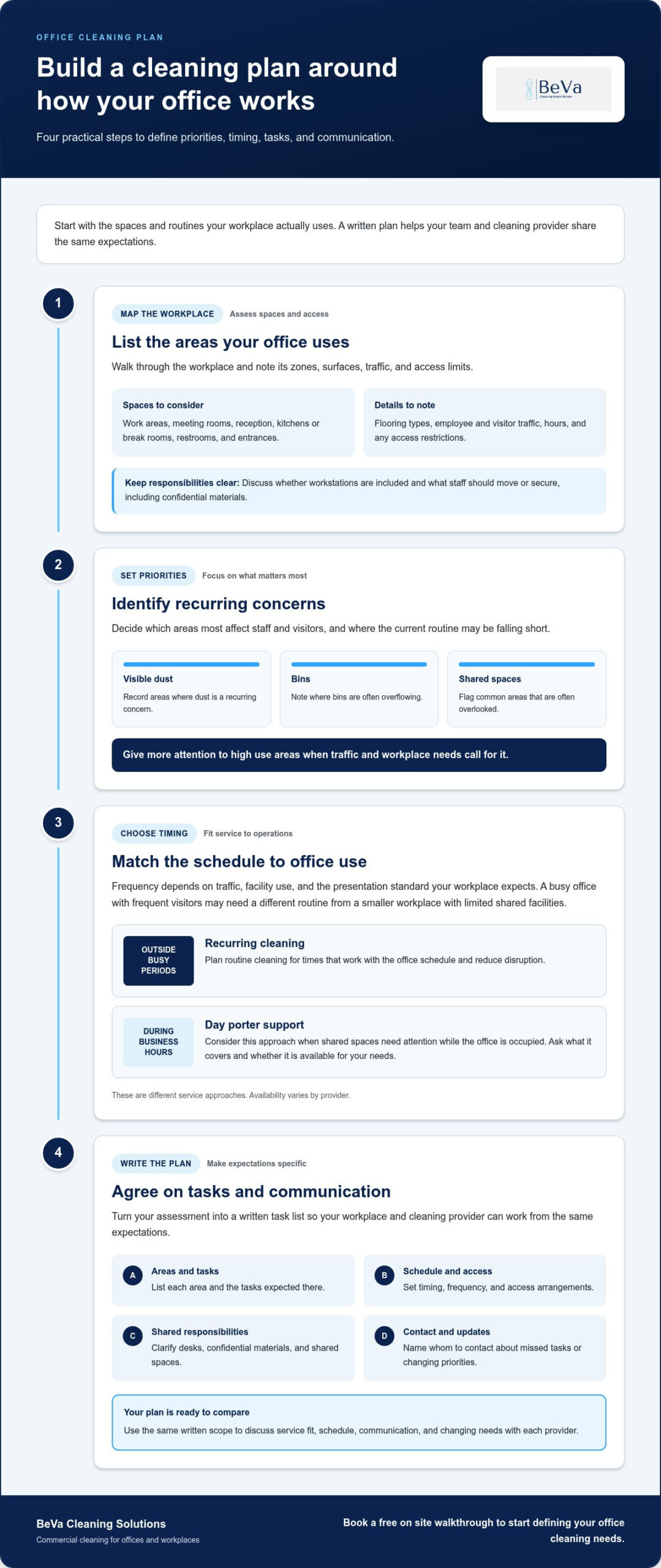
Walk through the workplace and make an inventory of work areas, flooring types, restrooms, kitchens or break rooms, meeting spaces, and high-traffic entrances. Consider employee count and visitor traffic, too. A client-facing reception area may need more frequent attention than a lightly used meeting room.
Note recurring concerns, such as visible dust, overflowing bins, or shared spaces that are often overlooked. Record access restrictions and the hours when cleaning can happen with minimal disruption. OSHA’s sanitation standards provide a workplace reference point, but your provider’s agreed scope should spell out the specific tasks and areas included.
Set timing around how the office operates
Service frequency should reflect traffic, facility use, and the standard of presentation your workplace expects. A busy office with frequent visitors may need a different routine from a smaller workplace with limited shared facilities. Look for signs that your current routine isn’t keeping pace, then use the published guide on signs an office needs professional cleaning as another prompt for assessing your needs.
Compare routine cleaning outside busy periods with daytime support for spaces that need attention while the office is occupied. These are different approaches, and availability varies by provider. Day porter cleaning may suit facilities that need attention during business hours. Ask whether it fits your needs and what it covers.
Define tasks and communication
Turn your assessment into a written task list. Specify the areas to be cleaned, the tasks expected in each area, the schedule, access arrangements, and whom to contact about a missed task or changing priority. Clear responsibilities prevent assumptions, especially around desks, confidential materials, and shared facilities.
- Assess: Document zones, surfaces, traffic, and access limits.
- Prioritize: Identify the issues that most affect staff and visitors.
- Schedule: Match service timing and frequency to facility use.
- Communicate: Agree on a contact and a process for updates.
This framework gives you a practical way to brief a cleaner for office cleaning and compare proposals on the same terms. If you’re exploring a regional commercial cleaning partner, review commercial cleaning services and confirm location and service fit.
How to Compare an Office Cleaner Beyond the Task List
A task list shows what a provider proposes to clean. A useful comparison also shows whether the scope is clear, the schedule fits your operations, communication is straightforward, and the service can adapt if your facility changes. A detailed proposal gives you more to evaluate. A brief one may leave responsibilities open to interpretation. Ask for clarification rather than assuming what’s included.
| Criteria | Questions to ask | Provider response |
|---|---|---|
| Scope | Which areas and tasks are included, excluded, or handled at a different frequency? | ________________ |
| Schedule | What timing is available, and how will it work around our operating hours? | ________________ |
| Communication | Who should we contact about a missed task or a change in priorities? | ________________ |
| Changing needs | How do we update the plan if occupancy, rooms, or hours change? | ________________ |
| Service approach | Would recurring janitorial cleaning or daytime support better fit our facility? | ________________ |
Ask how service issues are handled
Find out how staff report a concern, who reviews it, and what follow-up to expect. For example, if a shared area is missed, you should know whom to notify and how a change to the routine will be discussed. Clear communication doesn’t guarantee that issues won’t arise, but it helps both sides understand how to address them.
You can also ask how the provider manages its quality and service systems. ISSA’s Cleaning Industry Management Standard (CIMS) outlines a framework for cleaning-industry management and service delivery. Treat it as a reference for questions, not an assumption that a provider holds a particular certification.
When is day porter support a better fit?
Day porter cleaning may suit an occupied facility that needs attention during business hours. Recurring janitorial visits provide scheduled ongoing care, while day porter support addresses needs that arise as people use the space. Neither approach is right for every office. Consider traffic patterns, shared facilities, and your preferred presentation, then ask what each service includes. The published guide to day porter cleaning services can help you explore the approach in more detail.
Compare answers, not just task names. A good fit is one where the scope, schedule, communication, and service approach align with the way your workplace operates.
How to Prepare Your Office for a Reliable Cleaning Routine
A well-prepared workplace makes it easier to follow the agreed cleaning scope and address issues without confusion. Before service begins, confirm access, priority areas, supply responsibilities, and how your team and provider will communicate. A named point of contact can coordinate changes and gather feedback, so employees know whom to tell when something needs attention.
What should office managers confirm before service starts?
Write down practical site details and review them with the provider. Clarify building access procedures, service windows, restricted rooms, and instructions for entering or securing specific areas. Note which spaces take priority and how the cleaning team should be informed if access or workplace needs change.
Agree on a simple way to report concerns and track follow-up. For example, decide who receives feedback, how they share it with the provider, and how both sides confirm that an issue has been addressed. A janitorial cleaning guide for facility managers can help inform your preparation. Match general advice to your written scope and site requirements.
- Access: Confirm entry procedures, service windows, and restricted areas.
- Priorities: Document the spaces and tasks that need particular attention.
- Supplies: Clarify what the provider brings and what the office is expected to supply, if anything.
- Communication: Name a contact for schedule changes, questions, and service feedback.
Keep these details in one agreed document. It gives the office and the cleaning team a shared reference, particularly when occupancy, room use, or operating hours shift.
How can employees help maintain a clean shared workplace?
Employees can support the routine by clearing personal items from surfaces scheduled for cleaning and securing confidential materials. Set clear expectations for shared spaces, too. Staff can return meeting rooms to a usable state and leave kitchen areas ready for the agreed cleaning tasks.
These habits help the team access the areas included in the scope, but they don’t replace professional service. The provider remains responsible for the work agreed in the cleaning plan. Employees help make access and responsibilities clear.
Once the routine is documented, share the relevant instructions with staff and tell them whom to contact with concerns. If you’re planning recurring janitorial care, explore janitorial cleaning for your facility and confirm which tasks and arrangements fit your workplace.
Choosing an Office Cleaning Partner in Chicago and Northwest Indiana
The right partner should fit the way your workplace operates, not just offer a list of cleaning tasks. Before choosing a cleaner for office cleaning, bring together what you’ve learned: your facility’s priorities, a written scope, a workable schedule, clear communication, and services suited to the spaces that need care.
BeVa Cleaning Solutions serves commercial clients in Chicago, Munster, Dyer, Highland, and Crown Point. If your facility is in one of these locations, confirm directly whether your address and requested service are within the current coverage area. A conversation should establish fit rather than assume availability.
Which BeVa services may fit an office environment?
Recurring commercial janitorial care may suit offices that need ongoing cleaning as part of a planned routine. For a facility that needs attention while it’s occupied, day porter support is another option to discuss. The best fit depends on your workplace’s traffic, shared spaces, operating hours, and desired service schedule.
Hard floor services may also be relevant if your office has floor-care needs beyond routine cleaning. Describe the floor types and the condition or concerns you’ve noticed, then ask whether this specialized service fits the scope you’re considering. Not every facility needs every service.
What should you share when asking about office cleaning?
Give a prospective provider enough detail to understand your workplace and discuss a suitable approach. Share your location, facility layout, operating hours, and priority areas. Explain current challenges, such as shared spaces that need more attention or cleaning tasks that aren’t clearly assigned. If you’re considering daytime support, mention what needs arise while the facility is occupied.
It also helps to have your preferred task list and schedule ready. That makes it easier to discuss responsibilities, access, communication, and specialized needs without relying on assumptions. BeVa’s commercial cleaning and janitorial services, day porter support, and hard floor services may be options to discuss based on your facility’s requirements.
A clear conversation can help you determine whether the service approach and location are a practical match. Discuss your commercial cleaning needs with BeVa Cleaning Solutions.
Build a Cleaning Plan That Works for Your Office
A dependable office cleaning arrangement starts with a clear understanding of your facility. Define the areas and tasks that matter, put the scope in writing, and choose a schedule and communication process that fit your operations. Those basics make it easier to compare providers and set shared expectations.
The right cleaner for office cleaning should match your workplace’s needs, not just offer a broad task list. BeVa Cleaning Solutions focuses on commercial facilities, with janitorial and day porter services to discuss for ongoing care or attention during business hours. Specialized hard floor and high-rise window cleaning may also be relevant when your building has those specific needs.
Before reaching out, gather your location, facility layout, operating hours, priority areas, and current cleaning concerns. These details help start a practical conversation about service fit. Confirm that your location and requested services are available, then discuss the scope and schedule that make sense for your facility.
Discuss your commercial cleaning needs with BeVa Cleaning Solutions. A thoughtful plan can help your office feel more professional and make cleaning easier to manage.
Frequently Asked Questions
What does an office cleaner typically clean?
A cleaner for office cleaning may handle agreed tasks across work areas, shared spaces, kitchens, restrooms, and floors. The exact scope depends on your facility and service arrangement, so confirm what’s included and excluded before work begins. Ask how often each area will be cleaned, how the team will access it, and whether employees must clear personal workstations or secure sensitive materials. Clear responsibilities help prevent missed expectations.
How often should an office be professionally cleaned?
The right cleaning schedule depends on employee and visitor traffic, shared facilities, operating hours, and the presentation standard your business needs. A smaller office with few visitors may have different priorities from a busy workplace with frequently used meeting rooms and kitchens. Identify high-traffic areas and recurring concerns, then discuss them with a provider. Agree on a routine that reflects how your facility is used, rather than choosing a schedule by default.
What is the difference between an office cleaner and a day porter?
Scheduled office cleaning generally covers janitorial tasks completed at agreed times, while a day porter provides attention during business hours as facility needs arise. A porter may suit an occupied workplace with busy shared areas that need care throughout the day. The best approach depends on traffic, occupancy, and service scope. Some facilities may benefit from both recurring janitorial cleaning and day porter support, but neither option is automatically right for every office.
How much does office cleaning cost?
There’s no single price that applies to every office, and a specific quote depends on the work involved. Factors may include facility size, requested tasks, cleaning frequency, floor types, access arrangements, and schedule. Ask each provider to explain what the proposal includes and what could change the scope. For a useful comparison, give providers the same task list and facility details, then review the proposed services rather than relying on a headline figure alone.
What should I ask before hiring an office cleaning company?
Ask which areas and tasks are included, how often they’ll be completed, and how the schedule fits your operating hours. Clarify building access, whom to contact with concerns, and how missed tasks or changing priorities are handled. If your facility has specialized floor-care needs, ask whether the provider offers a relevant service. Clear answers help you compare proposals on consistent terms and set expectations before recurring service begins.
Ask which areas and tasks are included, how often they’ll be completed, and how the schedule fits your operating hours. Clarify building access, whom to contact with concerns, and how missed tasks or changing priorities are handled. Clear answers help you compare proposals on consistent terms and set expectations before recurring service begins.
Can office cleaning be scheduled outside business hours?
Some businesses prefer cleaning outside their busiest hours, but available service windows depend on the provider and building access arrangements. Ask which schedules are offered, how security procedures work, and whether any rooms need to remain accessible. Don’t assume that a particular time is available until it’s confirmed. If your office also needs attention while occupied, ask whether day porter support may suit the facility’s needs.
Does BeVa Cleaning Solutions clean offices in Munster, Dyer, Highland, Crown Point, and Chicago?
BeVa Cleaning Solutions serves commercial clients in Munster, Dyer, Highland, Crown Point, and Chicago. Confirm current coverage and service availability for your specific address before proceeding. When you reach out, share your city, facility type, operating hours, layout, and priority areas. This information helps clarify whether BeVa’s commercial janitorial or day porter services may fit your workplace.