A law office can look polished at reception and still leave clients wondering whether the details are under control. A search for “janitorial services for law firms Chicago” should lead to more than a tidy lobby: the right partner helps keep client-facing areas presentable while respecting boundaries around sensitive workspaces. That balance matters every day, and Chicago salt and slush can make busy entrances harder to maintain.
Cleaning needs to fit around meetings, staff, and client visits, not disrupt them. The firm also needs clear answers about what gets cleaned, when teams may enter, and how concerns are communicated. A practical plan can reduce the work of managing upkeep and help create a calm, welcoming environment for clients and staff.
This guide explains how to evaluate a cleaning provider for a Chicago law office, define a useful scope and schedule, and set expectations for restricted areas and communication. It also covers when recurring janitorial service or day porter support may fit your office’s needs, and what to confirm before choosing a partner.
Key Takeaways
- Match cleaning priorities to each room’s purpose, from client reception areas to shared staff spaces.
- Use a written scope to clarify tasks, frequency, and firm-set access boundaries for janitorial services for law firms Chicago.
- Compare providers on schedule fit, communication, work documentation, and follow-up when priorities change.
- Plan service around office occupancy and legal-office routines, then decide whether daytime or after-hours cleaning best fits operations.
- Use a site walkthrough to identify priorities and restricted areas before agreeing on a scope and schedule.
What Chicago law firms need from janitorial services for law firms Chicago
A law office needs to feel ready for clients without making cleaning a distraction for attorneys and staff. Reception areas should look composed, meeting rooms should be ready for the next appointment, and shared spaces should remain comfortable through the workday. The plan also needs to respect the firm’s routines and stay clear of sensitive work.
Law-firm janitorial service is a tailored commercial cleaning scope that aligns room-by-room upkeep with a firm’s client experience, work patterns, and access boundaries. The scope should reflect how the office is actually used, rather than treating every room alike. For a general overview of the field, see Commercial cleaning.
Which law-office areas shape the cleaning plan?
Group spaces by purpose: client-facing areas such as reception and conference rooms; staff workspaces; shared facilities such as restrooms and kitchens; and rooms with restricted access. Each group has different priorities. A conference room may need attention between meetings, while a shared kitchen may need a routine that accounts for daily use. Identify spaces with special access instructions before service begins.
Visible touchpoints influence how a visit feels. A tidy reception counter, clean conference table, and orderly restroom all contribute to a professional impression. In Chicago, winter salt and slush can collect at busy entrances. Include entrance attention in the proposed scope, and ask how routine janitorial work differs from periodic hard floor services when floors need more than regular upkeep.
How should cleaning respect confidentiality?
The firm should set access rules and communicate them clearly before service starts. Identify rooms that are off-limits, spaces that require permission, and the firm-approved process for gaining access. The firm should secure documents, case files, and personal materials. Cleaning staff should not be expected to handle files, open drawers, or decide whether materials can be moved.
Cleaning responsibilities are separate from legal work, records management, and the firm’s security responsibilities. Clear boundaries help prevent confusion and support an orderly working relationship. When evaluating janitorial services for law firms Chicago, check whether the proposed scope makes those boundaries easy to understand and follow. Ask how access instructions will be recorded and how the firm can report a concern or update priorities. A clear plan supports client-ready spaces while allowing legal work to continue with less disruption.
Build a law-firm janitorial scope around rooms, routines, and access
A useful scope turns broad expectations like “keep the office presentable” into clear, room-specific tasks. Set frequency according to occupancy, how often each space is used, and the firm’s priorities, not a universal template. The janitorial cleaning guide for facility managers can help frame the planning conversation, but the final scope should reflect your office.
What belongs in reception, conference-room, and office routines?
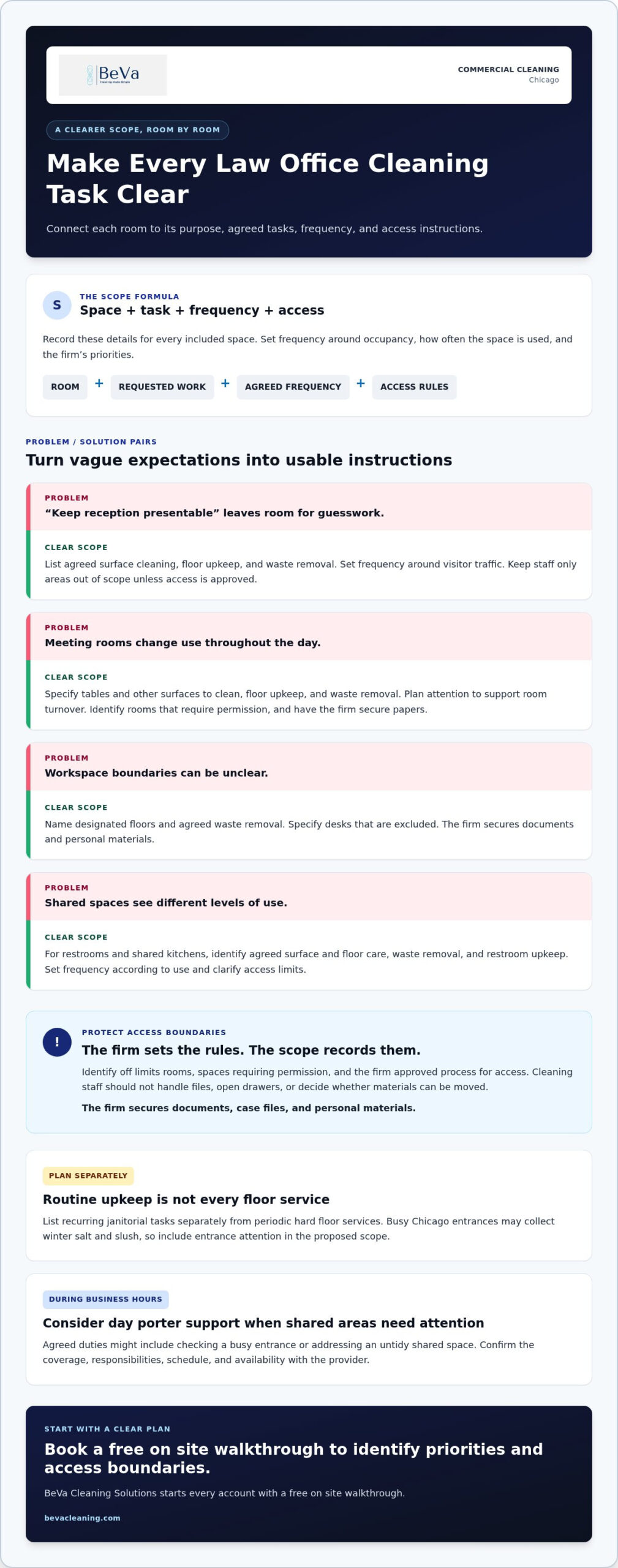
Use a simple matrix to record each space, requested work, agreed frequency, and access instructions. These examples are starting points, not a prescribed schedule:
- Reception: Clean agreed surfaces, maintain floors, and remove waste. Set frequency around visitor traffic. Keep staff-only areas outside the scope unless access is approved.
- Conference rooms: Clean tables and other specified surfaces, maintain floors, and remove waste. Schedule attention to support room turnover. The firm should secure papers and identify rooms that require permission.
- Staff workspaces: Maintain designated floors and remove waste at the agreed frequency. Specify which desks are excluded, and have staff secure documents and personal materials.
- Restrooms and shared kitchens: Include agreed surface and floor care, waste removal, and restroom upkeep. Set frequency according to use, and clarify any access limits for shared or staff-only areas.
List routine janitorial tasks separately from periodic hard floor services or other specialty cleaning. That makes it easier to see what is part of recurring service and what needs separate planning. If environmental standards matter to your firm, review Green Seal certified cleaning services as a reference for evaluating the standard, without assuming a provider holds that certification.
For janitorial services for law firms Chicago, write down the task, frequency, and access requirements for every included space. This shared record helps the firm and provider begin with the same expectations.
When do day porter services fit a law office?
Day porter support may suit an office that needs attention to shared areas or visible facility needs during business hours. Agreed duties might include checking a busy entrance or addressing an untidy shared space. Confirm the actual coverage, responsibilities, schedule, and availability directly with the provider. BeVa Cleaning Solutions lists commercial janitorial and day porter cleaning. Firms can discuss janitorial and day porter options and verify whether service is available for their Chicago address.
Compare Chicago janitorial providers on reliability, communication, and fit
A polished proposal is only useful if it explains how the work will happen and how the firm can raise concerns. Compare providers against the same criteria to judge practical fit, not just broad promises. A useful proposal makes tasks, frequencies, exclusions, and responsibilities clear.
Use this checklist during provider conversations:
- Scope clarity: Does the written proposal identify included tasks, agreed frequencies, exclusions, and who supplies necessary instructions?
- Communication: Who is the firm’s point of contact? How are access instructions, schedule changes, complaints, and quality concerns shared?
- Schedule fit: Can the proposed service times work around occupancy, meetings, and client visits? Confirm which schedule options are actually available.
- Documentation and follow-up: Ask how completed work is recorded, how missed tasks are reported, and who responds when priorities change.
- Local and commercial fit: Confirm service availability for the specific Chicago address. Ask for references relevant to similar commercial settings, where available.
For a law office, a strong fit also means the provider understands and follows the firm’s stated access boundaries. Ask who on the firm’s side defines restricted areas, how those instructions reach the cleaning team, and which contact should be notified if an instruction is unclear. Don’t assume any particular screening, certification, or legal-industry experience. Ask about the requirements your firm has set and confirm what the provider can document.
What should a law firm ask before signing?
Request a written scope that distinguishes included work from exclusions and records the agreed frequency for each task. Clarify how schedule changes and complaints are communicated, who receives them, and what follow-up the firm should expect. For cleaning standards, the CDC cleaning and disinfection guidelines can provide useful reference material as the firm defines its own expectations.
How can a firm judge service quality over time?
Before service begins, agree on observable standards for priority spaces, such as reception surfaces being visibly clean or meeting rooms being ready for use. Choose a practical review cadence and a clear process for documenting and resolving concerns. Then assess whether agreed work is completed consistently and communication is responsive. These real-world measures offer a more useful comparison than sweeping assurances.
When assessing janitorial services for law firms Chicago, verify the proposed scope, schedule, and coverage for your office directly with each provider. BeVa Cleaning Solutions lists commercial janitorial services in the Chicago area. You can ask about commercial janitorial service and confirm address-specific availability and details.
Set a cleaning schedule that works around Chicago legal-office routines
A workable schedule protects time for legal work while keeping the office presentable throughout the day. Start with a planning sequence, then confirm the proposed timing and duties with the cleaning provider. BeVa Cleaning Solutions offers commercial janitorial and day porter services in the Chicago area, but service availability, schedule, and scope should be verified for your specific address.
- Map occupancy. Note typical arrival and departure patterns, busy periods, client meetings, and conference-room use. Flag spaces where cleaning could interrupt calls, document review, or confidential conversations.
- Prioritize spaces. Identify areas that need attention most often, such as reception, restrooms, shared kitchens, and frequently used meeting rooms. Set priorities according to actual traffic and firm needs.
- Set access rules. Specify which rooms may be entered, which areas require approval, and who can authorize access or schedule changes. Share instructions through a designated firm contact.
- Review and adjust. After service begins, assess whether the timing and agreed tasks fit real office routines. Update priorities through the agreed communication process if occupancy or meeting patterns change.
How should firms plan around client meetings and staff schedules?
Compare daytime and after-hours arrangements based on the firm’s operational preferences, access rules, and the provider’s actual availability. Daytime service may call for attention to shared areas while staff and visitors are present. An after-hours arrangement may reduce overlap but still needs clearly defined entry instructions. Neither option is automatically right for every office. Decide who can approve changes, then document how that person will notify the provider so changing meetings don’t create confusion.
For more planning context, consult the commercial cleaning guide for Chicago. Use it alongside a site-specific discussion to shape a schedule around your firm’s routines, rather than assuming a standard plan will fit.
What should Chicago offices plan for during winter?
Snowy or wet conditions can bring salt, slush, and moisture into entryways and shared paths. Discuss which entrance areas should receive attention, then agree on floor-care tasks and frequency that suit the building’s actual surfaces and use. Ask the building team to address site-specific safety concerns. A cleaning schedule should not be treated as a safety guarantee.
A clear routine can help janitorial services for law firms Chicago fit the office rather than compete with its workday. Discuss commercial cleaning for your Chicago office and confirm address coverage, proposed timing, and responsibilities directly with the provider.
Choose a law-firm janitorial partner and start with a clear walkthrough
The right provider is one whose written scope fits the office and respects access rules set by the firm. A walkthrough helps turn general expectations into a site-specific plan. Both sides can identify room types, priorities, restricted spaces, and building needs before agreeing on tasks or timing.
Prepare a few details in advance to keep the walkthrough focused:
- Floor plan or room list: Mark restricted rooms, excluded spaces, and areas that need special access instructions.
- Operational priorities: Note preferred service windows, high-traffic spaces, meeting patterns, and cleaning concerns that matter most to staff or clients.
- Firm contact: Choose who can approve the scope, clarify access rules, and communicate changes or concerns.
- Site-specific needs: Identify features such as busy entrances or floor surfaces that may affect the proposed work.
Use the visit to check that the provider understands the boundaries as well as the cleaning tasks. Ask how the written proposal will reflect the firm’s instructions, what is excluded, and which details still need confirmation. A clear record gives staff and the provider a shared point of reference as service begins.
How does BeVa’s commercial service fit the next step?
BeVa Cleaning Solutions serves commercial clients in the Chicago area and lists commercial janitorial and day porter cleaning among its offerings. Recurring janitorial service may suit a firm seeking consistent upkeep, while day porter support may be worth discussing if needs arise during business hours. The right fit depends on the office and the duties, schedule, and coverage that can actually be arranged.
BeVa identifies Chicago, Munster, Dyer, Highland, and Crown Point among its service locations. Bring your office address, room list, access requirements, and preferred service windows to the conversation. Confirm directly with BeVa whether the address is covered and what scope, schedule, and day porter availability may be possible. That discussion can help establish a practical starting point without assuming every requirement is already covered.
If you’re evaluating janitorial services for law firms Chicago, a clear walkthrough is a useful next step toward a plan that fits the office and supports a professional client experience. Request a conversation about commercial cleaning.
Move Forward With a Cleaning Plan That Fits Your Firm
Choosing janitorial services for law firms Chicago starts with a practical fit: the written scope should match how your office is used, make firm-defined access boundaries clear, and set a schedule that works around legal work and client visits. A walkthrough can turn those priorities into specific tasks, responsibilities, and communication expectations.
BeVa Cleaning Solutions lists commercial janitorial and day porter services among its offerings, and Chicago is included in its stated service area. Confirm coverage for your specific office address, along with the proposed scope, schedule, and day porter availability. That conversation can help your firm determine whether the service options align with its operational needs.
Bring your room list, access instructions, and preferred service windows to the discussion. Discuss janitorial service for your Chicago law office and take a clear first step toward a clean, welcoming environment for clients and staff. A thoughtful plan can make upkeep easier to manage and help your team focus on its work.
Frequently Asked Questions
What do janitorial services for law firms typically include?
Janitorial service generally covers the recurring cleaning tasks agreed for specific areas of an office. A law firm might include surface and floor care, waste removal, and restroom upkeep in its written scope, with tasks and frequencies tailored to room use. Periodic hard floor services may need to be planned separately from routine janitorial work. Confirm exactly what the provider includes, excludes, and can perform at your office.
How can a law firm protect confidential information when cleaners visit?
The firm should establish and communicate access rules before service begins. Mark restricted rooms, specify any areas that require permission, and name a contact who can clarify instructions. Staff should secure case files, documents, and personal materials rather than expecting cleaners to move or manage them. Cleaning arrangements don’t replace the firm’s own responsibilities for records management and security, so keep those processes under firm control.
Should a Chicago law office schedule cleaning during the day or after hours?
Choose timing based on office occupancy, client appointments, access preferences, and the provider’s confirmed availability. Daytime service may suit firms that want attention to shared spaces during business hours, while an after-hours arrangement may reduce overlap with meetings and legal work. Either option needs clear entry instructions and a process for schedule changes. Discuss the trade-offs with the provider instead of assuming a particular time is available.
How often should a law firm schedule janitorial cleaning?
Set frequency according to occupancy, room use, and firm priorities rather than relying on a one-size-fits-all schedule. A frequently used conference room may need attention more often than a low-traffic office, while restroom and shared-space needs depend on actual use. List the agreed frequency for each area in the written scope, then review it if staffing, visitor traffic, or office routines change.
Can a janitorial provider clean a law office without handling case files?
Yes. The scope can define which areas may be cleaned and explicitly exclude handling files, papers, or materials on desks. The firm should secure documents and personal items, identify desks or rooms that are off-limits, and communicate access instructions before service begins. If a cleaner encounters an unclear situation, the agreed process should direct them to the firm’s designated contact rather than asking them to make decisions about legal materials.
What should a law firm ask before hiring a Chicago janitorial company?
When comparing janitorial services for law firms Chicago offices, ask providers for a written scope, task frequencies, exclusions, and access responsibilities. Also clarify who handles schedule changes, complaints, missed tasks, and follow-up, and how completed work is documented. Ask whether the provider serves your specific address and can share relevant commercial references. Confirm that the proposed schedule and duties fit your office before proceeding.
Are day porter services useful for law firms?
Day porter service may be useful if an office needs attention to shared areas or visible facility needs during business hours. Discuss and confirm the duties, coverage, and schedule with the provider. BeVa Cleaning Solutions lists day porter cleaning and identifies Chicago, Munster, Dyer, Highland, and Crown Point among its service locations. Confirm availability for your particular address and the specific support your firm needs.